Carvana: Buy/Sell Used Cars
- 4.8
- Rating
- 1.00M
- Installs
- Free
- Price

 Analysis by App-foxy
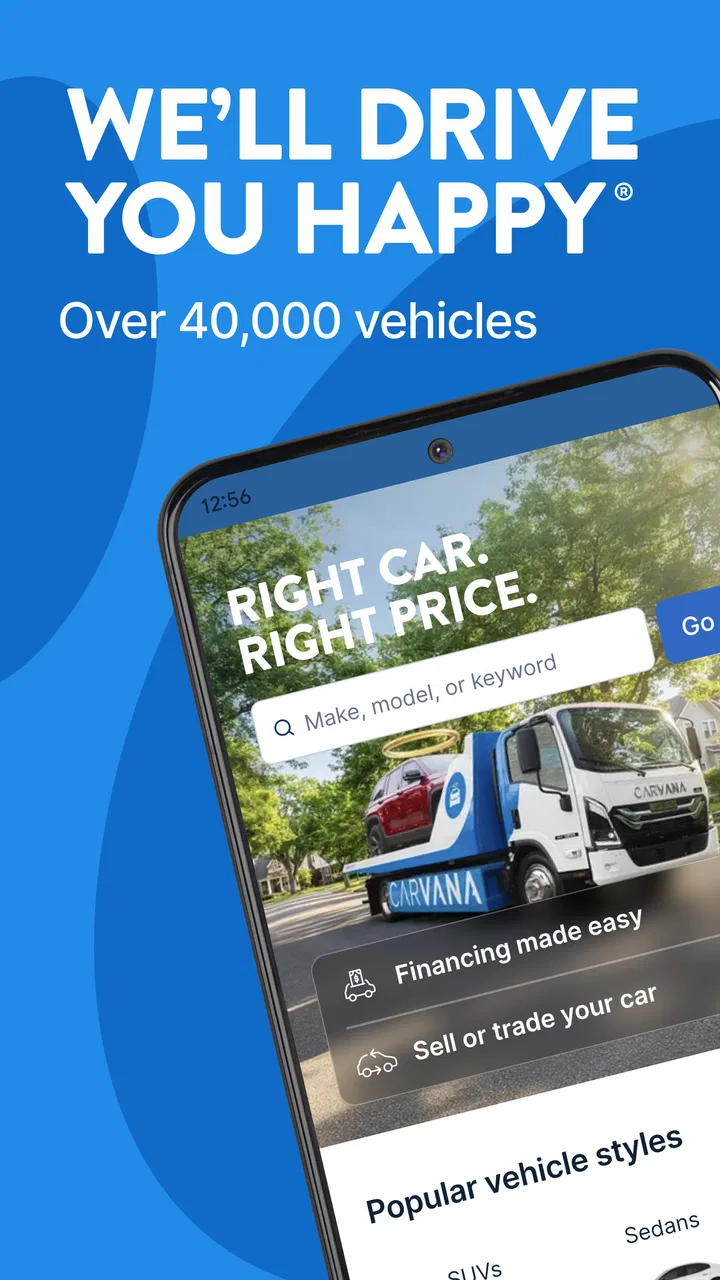
Buying a used car usually involves several separate tasks: finding suitable vehicles, checking their condition, arranging financing, organizing delivery or collection, and deciding what to do if the car does not meet expectations. I found that Carvana brings much of that process into one mobile experience, which is its main appeal. It is not simply a catalog of vehicles; it is designed to make browsing and purchasing feel closer to online shopping than to visiting several dealerships.
My overall view is positive, with an important qualification: Carvana is most useful when convenience and a broad digital buying process matter more to you than inspecting cars in person before committing. The app is free, aimed at everyone, and developed by Carvana. Its store summary highlights seven-day returns on all cars, a policy that gives the experience a useful safety net, although it does not remove the need to read the conditions carefully and make a decision quickly.
How the Carvana experience works in everyday use
When I open the app, the natural starting point is searching for a vehicle rather than trying to understand a complicated menu. That suits the way most people shop for a used car: I may begin with a body style, a budget, a preferred make, or a practical need such as space for children and luggage. The value of the app is that it lets me move from casual browsing to a more focused shortlist without immediately having to speak with a salesperson.
You May Also Like

 Blood Strike: 2.5 Anniversary
Blood Strike’s Loadouts Turn Every Drop Into a Tactical Gamble
A close look at Blood Strike’s custom loadouts: how fast access to signature weapons reshapes its battle royale rhythm, rewards preparation, and narrows the gap between fights.

 Pandora - Music & Podcasts
Pandora’s Music Is Easy to Start, but Harder to Recover
Pandora’s strength is its low-effort path from a seed to a station. Its weak spot is how much confidence it asks you to place in connection, setup, and quiet recovery.

 8 Ball Pool
 Is Built on Rivalries, Rematches, and Routine
A close look at the rivalries, rematches, shared routines, and unanswered safety questions that turn a quick pool match into a persistent mobile community.

 Samsung Music
’s Quiet Strength Is Playing What You Already Own
Its reach comes less from spectacle than from dependable access to a personal library. That simplicity is both the app’s strongest retention engine and its ceiling.

 AccuWeather: Weather Radar
AccuWeather Review: A Quick, Clear Forecast for Everyday Decisions
For everyday plans, the best forecast is the one you can understand quickly. AccuWeather makes rain timing, radar, and local conditions easy to act on, with a few trade-offs.

 Hill Climb Racing
Why Hill Climb Racing Still Turns Crashes Into One More Run
A tiny car, a bumpy hill and one more upgrade: Hill Climb Racing keeps resurfacing because its simple chaos makes every near-miss feel personal.
More From Our News Desk



I found the mobile format particularly convenient for comparing cars at different moments during the day. A person can browse during a commute, save a promising vehicle for later, and return to it when they have time to think. That matters because used-car shopping is rarely a single-session decision. A car that looks attractive at first may become less appealing after I compare its mileage, equipment, location, and total purchase implications with another listing.
The app belongs in the Auto & Vehicles category, but I would describe it more specifically as a digital marketplace and buying tool for used cars. It is not a general automotive reference app, a repair tracker, or a social community. Its purpose is much narrower and more practical: helping me discover vehicles and move through the buying or selling journey from a phone.
That focus is a strength. I do not have to switch between a classifieds service, a dealer page, and a separate place to manage the next steps. At the same time, the focused design means it is not the best companion for someone who wants extensive mechanical education, independent repair advice, or a complete ownership dashboard after the purchase.
Browsing is strongest when I already know my priorities
The app works best when I enter the search with a clear idea of what matters. For example, if I need a compact vehicle for city driving, I can judge candidates against a short list of practical requirements instead of being distracted by every attractive option. I recommend deciding in advance which factors are non-negotiable, such as seating capacity, fuel type, transmission, or a maximum amount you are comfortable spending.
This is more than a general shopping tip. Used-car marketplaces can encourage endless browsing because every new listing looks like a possible improvement. In Carvana, I found it easier to stay disciplined when I treated the app as a comparison workspace rather than entertainment. I would save a few realistic candidates, note why each one made the list, and then remove cars that failed an important requirement.
A useful workflow is to separate “interesting” from “ready to buy.” An attractive photograph can make a vehicle feel familiar before I have considered its history, condition, or practical fit. Keeping a shortlist prevents one polished listing from receiving more attention simply because it appeared first. It also makes the eventual decision less emotional, especially when I am shopping under time pressure.
Why the return window changes the decision
The seven-day return promise is one of the most meaningful parts of the Carvana proposition. A used car can look convincing in photos and still feel wrong once it is parked at home. The return period creates room to notice things that are difficult to judge during a quick dealership visit, such as whether the seating position works, whether the cargo area fits everyday items, or whether the vehicle feels comfortable on a familiar route.
I would use that period as a structured evaluation rather than as a casual test drive. During the first day, I would check the basic controls, visibility, interior condition, warning lights, and paperwork. I would then drive the vehicle in the situations that match my normal routine. A short city trip, a parking session, and a longer road journey can reveal very different issues.
There is an important trade-off here. A return policy reduces the fear of making a poor choice, but it does not make an unsuitable purchase harmless. I may still spend time arranging insurance, changing plans, or returning the vehicle. I also should not assume that every condition is automatic or that a deadline can be ignored. Before committing, I would read the current return terms inside the buying flow and keep track of the relevant dates.
For me, the strongest way to use the policy would be to arrange an independent inspection as soon as possible, if that fits the applicable terms and local arrangements. A mechanic can notice concerns that a normal driver may miss. The app makes the purchase process more convenient, but convenience should not replace an objective check of a major financial decision.
The selling side is useful for reducing friction
Carvana also addresses people who want to sell a car rather than buy one. That makes the app more practical than a service focused only on browsing inventory. Selling privately can require writing an advertisement, responding to repeated messages, arranging viewings, negotiating, and handling payment concerns. A digital selling route may appeal to someone who values a simpler process over extracting every possible amount from the vehicle.
That convenience comes with a question I would ask before accepting an offer: how much is the saved time worth to me? A private sale may produce a different result, but it can also take longer and require more personal effort. A dealership trade-in may be easier when I am buying another car at the same time, while Carvana may be more attractive when I want a dedicated online route for selling.
I would prepare the vehicle information before starting. Having ownership documents, accurate mileage, service records, and details about the car’s condition nearby can make the process smoother and reduce the chance of an inaccurate description. I would also photograph the car honestly if the workflow requests images or condition details. Clear information is better than trying to make a vehicle appear perfect and dealing with questions later.
Where the app feels better than traditional alternatives
The usual alternative is visiting several dealerships, checking local classified listings, or contacting private sellers one at a time. Those methods still have advantages, especially for people who want to sit in a car before making any commitment. However, they can be inconsistent: each seller may present information differently, and comparing cars across multiple locations can consume an entire weekend.
Carvana’s advantage is the consistent digital starting point. I can browse from home, compare vehicles in a similar environment, and avoid beginning every conversation with a sales pitch. That is especially valuable for a buyer who dislikes negotiating or who has limited time because of work, family, or mobility constraints.
The comparison is less favorable for someone who enjoys inspecting several cars side by side. A local dealer may let me immediately compare seating positions, cabin noise, visibility, and ride comfort. A private seller may also answer detailed questions about how a particular car was used. Carvana offers a smoother remote process, but remote shopping naturally limits the first-hand impressions I can form before delivery.
Small details that can prevent a poor choice
One practical lesson is to judge the vehicle as a complete ownership decision, not just as a listing that fits a search. I would consider whether the tires, brakes, scheduled maintenance, insurance, and registration costs make sense for my situation. The app can help me find a candidate, but it cannot decide whether that candidate fits my monthly reality.
Another useful habit is to compare similar vehicles rather than comparing unrelated bargains. If I save one older premium car and one newer mainstream car, the cheapest displayed figure may not tell me which is more sensible. I would look at age, mileage, equipment, likely maintenance, and how long I expect to keep the vehicle. This approach turns the app into a decision aid instead of a stream of tempting options.
I would also avoid making a final decision late at night or immediately after finding a rare-looking listing. Scarcity can create pressure, even when the car is not truly the right fit. Saving the vehicle, reviewing the details in daylight, and discussing the choice with another person can expose assumptions I might otherwise overlook.
Meaningful limitations and points of friction
The biggest limitation is the distance between digital confidence and physical certainty. Photos and listing information can help me narrow the field, but they cannot fully reproduce the experience of opening the doors, checking the driving position, listening for unusual sounds, or seeing how the car fits in my parking space. The return option helps, but it is still better to approach the purchase carefully than to rely on returning a vehicle later.
Another limitation is that the app is not a substitute for independent research. I would still verify insurance implications, ownership costs, local registration requirements, and whether the vehicle suits my driving environment. Someone who lives in an area with severe weather, rough roads, or limited charging and fueling options should apply those local considerations rather than assuming a good listing is automatically a good purchase.
The app may also feel less satisfying to buyers who want a personal relationship with a local dealer or mechanic. A human conversation can reveal context that is difficult to capture in a listing, while a digital workflow favors speed and standardization. That is not a flaw for everyone, but it is a real difference in the buying experience.
On the technical side, the current version is 6.61.0 and requires an operating system version of 11 or newer. That is a reasonable requirement for many current phones, but anyone using an older device should check compatibility before planning to rely on the app. The service is free to install, and its age rating is Everyone, so the barrier is mainly whether the phone and the buying model fit the user.
Who should use it, and who should choose another route?
I think Carvana is a strong match for a buyer who wants to shop from home, dislikes dealership pressure, and can evaluate a car methodically after it arrives. It is also appealing to people with a busy schedule who would rather build a shortlist digitally than spend several days visiting separate lots. The return period makes the remote model more approachable for cautious buyers, provided they use the time intelligently.
It can also suit a seller who values a simpler process and wants to avoid arranging numerous private viewings. The best fit is someone who sees time, predictability, and reduced negotiation as meaningful benefits. For that person, a slightly less hands-on process may be a worthwhile exchange.
I would be more cautious about recommending it to someone who needs a car immediately and cannot tolerate delivery or return-related uncertainty. I would also point a highly hands-on buyer toward local dealerships or private sellers if sitting in the exact vehicle, inspecting it with a trusted mechanic, and comparing several cars in person are essential parts of the decision.
Likewise, a buyer with unusual requirements should not assume the app will solve every problem. If I need a very specific configuration, a specialized work vehicle, or a car with a particular modification, a local search may offer more useful context. Carvana is strongest as a streamlined route for mainstream used-car shopping, not as a universal answer to every automotive need.
My verdict after weighing convenience against control
Carvana succeeds because it addresses the most tiring parts of used-car shopping: scattered research, repeated conversations, and the discomfort of committing to a vehicle after only a brief inspection. Its mobile format makes browsing approachable, while the seven-day return promise gives buyers a practical opportunity to test whether the car works in real life.
Still, I would not treat the app as a magic shortcut. The buyer remains responsible for setting a sensible budget, reading the vehicle information closely, checking the car promptly, and understanding the return process. The best experience comes from combining the app’s convenience with independent judgment, not from allowing the polished digital process to make the decision for me.
With over a million installs and an average rating of 4.8 from around 78 thousand ratings, the app has clearly attracted substantial user attention. Those figures are encouraging, but my recommendation rests more on how well its model fits a particular shopper. The app is free, and the developer is Carvana, so it is easy to try as a research tool before deciding whether to complete a purchase through it.
My final recommendation is simple: use Carvana if you want a calmer, mostly digital way to search for or sell a used car and you are willing to perform careful checks yourself. Skip it in favor of local, in-person options if physical inspection and immediate human guidance matter more than convenience. For the right buyer, it turns a stressful process into a manageable sequence; for the wrong buyer, the distance from the vehicle may remain the central weakness.
FAQs for Carvana: Buy/Sell Used Cars
01What features does the Carvana app offer for buying and selling cars?
The Carvana app provides a seamless experience for buying and selling used cars. You can browse thousands of vehicles, view high-definition 360-degree images, and access detailed information about each car. For sellers, the app offers an easy process to get a real offer on your car within minutes. Additionally, it includes financing options and delivery scheduling.
02How does the Carvana return policy work?
Carvana offers a 7-day money-back guarantee, allowing you to test drive your car for a week to ensure it suits your needs. If you're not satisfied, you can return the vehicle within this period for a full refund. This policy provides peace of mind, ensuring you make a purchase decision you're comfortable with.
03Is financing available through the Carvana app?
Yes, Carvana provides financing options directly through the app. You can pre-qualify without impacting your credit score and instantly see your personalized financing terms. This feature makes it easy to understand what you can afford and simplifies the car buying process, eliminating the need to visit a bank or lender.
04How does Carvana ensure the quality of its vehicles?
Carvana conducts a rigorous 150-point inspection on every vehicle to ensure quality and reliability. Each car comes with a free CarFax report, detailing its history and any past accidents. This thorough vetting process helps to ensure that vehicles meet high standards, providing confidence in your purchase.
05What should I expect during the car delivery process?
Carvana offers a convenient delivery service, bringing your purchased car directly to your doorstep. You can schedule a delivery time that suits you, and a representative will guide you through the final steps of the transaction. Alternatively, you can choose to pick up your car from a Carvana vending machine for a unique experience.
Pros
- Easy-to-use interface for browsing cars.
- Quick financing options available in-app.
- High-quality car images and details.
- Seamless car delivery to your location.
- Comprehensive car history reports included.
Cons
- Limited in-person inspection options.
- Some regions have delivery restrictions.
- High delivery fees for certain locations.
- Trade-in values may be lower than expected.
- Occasional app performance glitches.

Carvana: Buy/Sell Used Cars
Gallery